Pages

Showing posts with label Somehow OSR. Show all posts

15 January 2016

Savage Hexcrawl - Part 4: Players' rules FAQ

My Savage Hexcrawl rules are almost two years old. Since then I have used them in few campaigns with different groups and with players new to the idea of hexcrawl. This post is a collection of answers for questions that kept popping out during those games.

How much time it takes to travel one move point?

Move points don't work that way. It is an abstraction that does not really take time into consideration. Think of move points as a combination of effort and skill in travel. People who are less suited for travel will have more trouble travelling the same path than a seasoned explorer does. Novices will get tired faster and they will get lost more often. So in general, it will take a character who receives 5 move points, twice as long to travel the same distance than a character who receives 10 move points. If you want an actual time required to travel one move point for for your character/party divide 8 hours by the amount of move points. So an average character with a Pace of 6 would spend around  1h 20min to travel one move point. I would advise you against translating everything into hours and minutes however. The system is abstracted and move points include things like stops for food and drink and getting lost and backtracking during travel and short encounters. If you spend 4h inside a hex doing normal "RPG adventuring" you don't loose any move points automatically. You are still able to travel as much, but now you risk travelling at night, as you wasted daytime. 

What move points do I get if I use different means of travel on the same day?

The system assumes that you will always use the fastest means of travel for the bulk of your journey. If you have a horse, you will ride it. If you have a car, you will drive it. But stuff happens. Horses might die and cars can run out of gas. There can also be terrain that does not allow different means of transport. A horse cannot climb a steep mountain and a car can't drive through a river. If you have to change means of travel your GM will need to do some math. Calculate roughly how many percent of your move points you have used. So if you spent 8 points while on a horse, you have spent 80% of your daily travel time. Take the remaining percentage and translate it to move points based on your new Pace. So if your horse died after 8 move points and you have to travel by foot you have (Pace x 100-80%, so 6x0.2) 1.2 move points left. Any fractions are rounded down as changing means of transport takes time - taking your equipment down etc. You are NOT getting a fresh set of move points based on your Pace (so 6 for Pace of 6) because the characters are already tired from the journey. Even riding in a car will tire you out. The same happens if you find a horse or a car in the midst of the day. You translate the remaining percentage. Your character is already tired from travelling this day.

What happens if I get Encumbered or Wounded?

If during your travels there is a negative change to character's Pace (Wounds, Tiredness and Encumbrance all affect Pace) and because of it you become the slowest in the party, the group automatically looses movement points. The amount you loose is equal to the difference between the original party Pace and the Pace of the character who just got Wounded, Tired or what have you. So if your party Pace was 5 and a character with Pace of 6 got two Wounds and got encumbered (making its new Pace 3), they loose (5-(6-3)=) 2 move points. This is why it is a better idea to setup a camp for the rest of the day to rest and heal before continuing the journey.

Why would I explore a Hex?

As mentioned in Part 1, you can spend a move point to explore a hex, but it is not explain what benefits does it give you. Exploring a hex makes the GM draw another card to check for Events. It lets the players seek more adventure, no Notice test, just card draw. Exploring is also used when trying to find something inside the hex if you don't know exactly where it is. GM might ask you to explore the hex and test Notice or you can explore it until a good event card shows up. So if you know that there is a small keep inside the hex, but don't know exactly where, you need to explore it, plain and simple. In metagaming it also adds to variety - you will add more entries to your notebook for that hex, which will make the world seem more alive.

Where am I inside the hex?

Short answer - doesn't matter. The system is abstract, it only matters that you are somewhere inside that six mile radius. Rest of it is not on the map, but in the minds of the GM and players. If you need some concrete info, you can travel to the middle of the hex by spending half of the point cost for the terrain type (so 2 for swamp or 1 for plains) and traverse it by paying all of it. If you enter a hex but don't have enough points to exit, or even a middle, just narrate where you are.Use your imagination  ;)


Those are all the questions that come to mind. If you have any more, feel free to ask them in comments and I will answer them here. I will eventually add some more GM advice and combine the hexcrawl info into a pdf.

06 July 2014

Who, What, Where, When, Why, How to improvise - part 2

In Part 1 of this article we established that a key to successful improvisation is to “Ask questions and use the answers”. If you want to create more fleshed out details you should ask yourself more than one question. Feel free to use a variant of the 5Whys technique. Don't concentrate on just the Whys - use any open ended question word (Who, What, Where, When, Why, How) you can/want to get more interesting answers. 

Before we move any further, try improvising some content for your current game from one of the questions below. Ask yourself a chain of at least 3 questions based on your previous answers to see what you can come up with. To get detail - think about your current game - the setting, the player characters and their past.

  • Who lives in this house?
  • What does this stranger want from you?
  • Where is the artifact hidden?
  • When will the assassin strike?
  • Why is there blood here?
  • How did this beast got in here?


It might seem tricky at first to come up with good answers on your own, but don't be discouraged. The goal of this silly exercise is to make you more confident with asking yourself open ended questions when fishing for answers, not to come up with great answer. Inspiration for great content will come to you as you play the game - party's previous exploits, setting details or even a piece of art... heck, maybe even one of those dreaded random tables! 

Now you know how to create some random content on the spot, let's see how to use it during a game.

Where to Start?

First of all, don't be afraid to fail when you start. Not everything you come up with on the spot will be gold. Even with years of practice, some things that you will come up with won't be great - and I speak from personal experience on that front. Don't get discouraged

When you are stating tinkering with improv, create a "safe space" in your game where you can fail and it won't matter. You can use a trick that I was almost abusing when I was starting - creating "side quests".

Prepare for your session as you would normally. 
As you do, identify some spots in the adventure, where player characters have some down time or are doing something that requires a lot of time - travelling, investigating, research etc. Now think of a few small things that COULD happen during this time. Ask yourself "What can happen to the [player] during [x]?". Meeting strangers while travelling, getting pick-pocketed while in a busy market - that sort of things. Write down few of those small things. If you want to experiment with random tables - come up with 6 things, so you can roll a D6 to find out what happens during the game.

As you get to this spot in the adventure, choose one of the things to happen to player characters. Let them interact with it. They will you some questions about the encounter and from that you can come up with some answers using the open ended questions. Just ask yourself a series of them in your mind and come up with something - anything. If it is not a great answer, nothing is lost - PCs will continue down your planned adventure. If, however, some of your answers will spark the players imagination - they will follow this little unscripted plot. Now you will have to ask yourself more questions to create more content. (Pro Tip: If you are short for ideas on the spot, excuse yourself to the bathroom or to grab a drink - use this time to come up with something juicy).

The beauty of this "side quest" approach is that you can stop it an any time without disturbing the overall plot. So whatever you come up with, you won't work yourself into a corner - plotwise. This way, you can't lose!
A word to the wise: before you start doing this often, tell your players that random things can happen to their characters. After all - it is a living world and not everything is connected to the adventure at hand.

What and When to Improvise?

When you are starting out, you should focus on improvising small details and adding some side quests for flavor. Add random details to the scripted content - maybe use a sense that you don't normally cover in your narration. Smell can be a powerful tool here, just add random smells to NPCs and locations. Add some small details to anything you can. A shield the PC found is not just a generic shield, it has dents, old blood stains and has a coat of arms of a local barony on it. Suddenly everything in the game world will seem more alive and complete. From that, players will ask you questions. Who did this shield belonged to? Did we just kill a noble? 

Those questions should be a trigger for you. They are an opportunity. They mean that the player is interested in some aspect of the world and they want to investigate it further. You want to answer those questions. Each of them is a potential side quest. And you know what a collection of interconnected side-quests is? A whole adventure. Unscripted! Just like that! 

Your players are your biggest asset when it comes to sparking your imagination. They will give you the ideas that you can develop on the spot into plots. Adventures created this way will seem more organic, more connected to the characters. You no longer require to come up with mysterious strangers to give the PCs a task. Players themselves are being proactive into creating their own adventures. You bait them with some random detail, and they will basically create the scenario for you. It's that simple - all you need to do is to answer some questions!

Go! Start Improvising!

04 July 2014

Who, What, Where, When, Why, How to improvise - part 1

If you followed this blog for a while you know that I love all kinds of improv in my tabletop roleplaying. I am pushing things like hexcrawl and random tables down my readers' throats for quite some time now... and will continue to do so. Don't get me wrong - I enjoy scripted adventures as much as any of you, but the constrains of adult life usually stop me from preparing those. So I turn to more free-form games - narrative RPGs, story games - basically things that were created for zero prep gaming. Those are great, but usually not suitable for long-term play. So, if I want to run a long term campaign in a traditional RPG, I improvise a lot.

And so can YOU!

The aim of this article is to show you how to start improvising during the game. I want to focus on the basics and give you the tools, so you can start tinkering with improv yourself. My approach to improv is by no means the only way to improvise during session, but it is something that has worked for me for years. I hope it will do the same for you.

Why Improvise?

I started improvising my games because I had less and less time to spend on my session prep. If you are having the same issue, I strongly encourage you to give improv a try. Even if the session is not as polished as a fully preped one, it is still better than no session at all, especially when time is a valuable commodity.
I kept improvising, because this style of GMing gives me a similar feeling to that of a player. The sense of wonder, discovery and surprise that every session brings. You won't know what hides around next corner. While you might know who the bad guy is, but you have no idea how the players will stop him. If you had been GMing for a long time, this approach will feel like a breath of fresh air. Not knowing all the details of the plot might seem a bit scary, but trust me, it is very rewarding and will create amazing stories.
Lastly, the way I improvise (or maybe just explain improvisation) includes some techniques that you will find helpful in your life away from table. They are are used in training programs for journalism, management and general problem solving. While I might sound like a snake oil salesman trying to push some dodgy product on you, those techniques (even if looking and sounding silly) can help in your everyday life.

Who Can Improvise?

Anyone!

No, honestly - anyone can improvise. It is a skill and like many others, can be learnt. Wannabe actors pay good money for improv classes. You, as a tabletop roleplayer, have a head start. If you had even been a player - you have improvised. If you ever had to wrangle players back to the plot while GMing - you have improvised.

It might not seem as such, because it was just a small part in a larger, pre-scripted, scenario. But this is exactly how you start. No one is asking you to start a session with 0 preparation and come up with an amazing story right away. I want you to start small and level up your improv skill over time. Improvisation is an art that builds up on input of others. In tabletop RPG terms it might be your PCs' past exploits, their background and their knowledge. It will also be based on the rules and contents of the world you are playing in. Lastly, the extra input will come from the players themselves - your friends around the table. Don't be afraid to share the improv load.

How to Improvise?

This is it. This is the Holy Grail that you traveled here for. Gone trough all those lines of text. Dear gods, so many letters! Now, the secrets to successful improvisation lay before you. Finally, you discover that to become an Improv GM you have to...

Ask Questions.

I know, I know. It seems quite disappointing, but this is the trick to improvisation during a session. Whenever you need to introduce some unscripted element in your games you need to ask yourself few open ended questions. You know, those questions that start with Who, What, Where, When, Why and How. They are called Five Ws (or as I knew them in the UK, 5 bums on the rugby post) and are commonly used in nformation-gathering. This is the exact formula I am using when I need to come up with something on the spot.

Let's say I need to introduce a NPC. I will ask myself few questions about him. How does he look like? What is his agenda? Where do players meet him? I go trough the same process with places, items, even with players questions: "What's in this castle?"

You don't have to answer all the questions that come to your mind. Answer the ones you can and go from there. Keep your answers within the boundaries of the setting. The castle might be owned by a baron who dabbles in necromancy in a dark fantasy, or it can be overrun by monsters crawling out of a portal in the dungeon in a heroic game. Each answer should lead you to a new question. Why does the baron want necromantic powers? Where does the portal lead to? Don't be afraid to introduce details from the PCs past. The baron has gone corrupt after you cleared out his black market and killed his lover, he wants to bring them back. The portal leads to a dimension where you banished that demon - he plots revenge by opening it near you. With a little practice you will be able to create content for your game like that in seconds.

Bottom line, to be good at improvisation you need to “Ask questions and use the answers”. Just remember to take details for your answer from the setting and the player characters' past - this will create truly memorable encounters.

Oh, one more thing - if you can't think of a good answer for your question, don't be afraid to ask the players. You can do it either "out of character" by just saying - "what do you think is in there?" or root it in the game world by connecting it to the player characters - "You used to serve under barons in this kingdom, do you remember anything about this castle?"

***

It is getting late and the post is getting long, so I will split it in two. Stay tuned for answers to such mind-boggling questions like: "Where to Start?" and "What and When to Improvise?"
Edit: Now you can check out Part 2!

29 June 2014

Procedural tabletop RPG content?

I have a soft spot for random generators. Random encounter tables help me design adventures on the fly, random critical hit effects add flavor to the battle scenes... and so on.
My obsession with random generator really started when I discovered rougelikes in the late 90s. It was when I learned what procedural generation is and I got hooked. There seems to be something magical and intriguing in the way a simple man-made algorithm can create a variety of content from random ingredients and formulas... and it seems that I am not the only one. This aspect of digital gaming seems to be quite popular nowadays. More and more developers are jumping on the random generation train. Either creating rougelike-like games (Spelunky, Binding of Isaac) or just adding randomized elements to their creations (like equipment in Borderlands and Skyrim).  Random dungeons, random loot, random enemies. It's everywhere! Even on a tabletop...

Tabletop procedures

Randomized board of Settlers of Catan
Random elements where always present in tabletop games. From simple random number generators (dice!), through randomized elements of board games, to the (in)famous random tables from the RPGs of yesteryear. While the RPG fandom moved away from all this randomness, preferring pre-made scenarios, a bunch of players (mainly those involved in the OSR movement) continued using random tables. With time, this practice evolved from simple random encounters with a fantasy critter corresponding to a number to fully fledged adventure generators that will create a hook, twist and nemesis for your session. On a Savage Worlds side of roleplaying games like Savage Worlds of Solomon Kane or Shaintar have good examples of such.

While random tables are being sort of a niche within the RPG niche they seem to thrive. There are whole websites dedicated to them that help inspire GMs. You can find a random generator for everything, from strange fungi consumption to city generation. Internet seems to be the right medium for those, as whole generators can be scripted to work in your browser and they don't get lost in a humongous binder full of printed tables. This, however, comes at a price - we have taken it away from the tabletop. Many GMs that I know use them exclusively to create adventures before the session and not taking advantage of them "on-the-fly".

Now, years after the birth of online random generators we see next step of this evolution - decks of cards that aim to help and inspire game masters in the art of improvisation. You probably seen some of them on Kickstarter in recent past. I am talking about projects like Concept CardsCreature & Encounter DecksCombat Description CardsThe GameMaster's Apprentice (this one is quite cool!). If you think about it, cards are a great tool for this sort of thing. Portable, quick and big enough to pack a good amount of content. When used by a skilled GM those can make for an amazing experience.
If you are curious about improvisation, I would encourage you to check some of them out. Each of those decks has a different flavor and different uses, so shop around to see what suits you.

What do you think about those card aids? What kind of info would you like to see on them? I am toying with an idea of creating some decks like that under CC license so people could create their own - would you be interested in such a template so you could create your own cards? After all, roguelikes survived and had their re-birth thanks to Open Development, why can't random "tables" have the same?

14 April 2014

Savage Hexcrawl - Part 3: GM's Encounter Rules

The "joys" of life slowed the savage hexcrawl in past few weeks down to a crawl (oh, bad puns!). Nevertheless the series is not abandoned and is continuing today with the topic of encounters. We have touched on this topic in Part 2 - where we looked at what encounters are and how they fit in into a random hex. In the Part 3, GMs will get the rules (or perhaps guidelines?) on how and when to select the encounters.


Want the rules right here, right now? No problem! Savage Hexcrawl aims to be Fast, Furious and Fun! Read the TL/DR section for bare-bone rules summary. Read the whole thing for more in-depth explanation and other musings.

TL/DR: During a hexcrawl journey, PCs can stumble upon various encounters. GM draws a card (more, if the area is rich in encounters) from action deck for each hex the party enters and every time they camp in the wilderness. 
Face cards signify an encounter. GM will either roll on a table, or have an encounter prepared.

What does the GM need?

First and foremost, when running a hexcrawl (or other sandbox campaign) the GM needs to be prepared to improvise. A set of random tables can aid this improvisation, but is not necessary. Some encounters might be a part of elaborate plots, but players won't pick up on that. Others, will just be a random creations that players will want to follow and create an adventure out of it. Both are fine. Sandbox is all about the freedom of choice. Be prepared to let go of your crafted plots and improvise. The GM will also need a deck of...

Cards

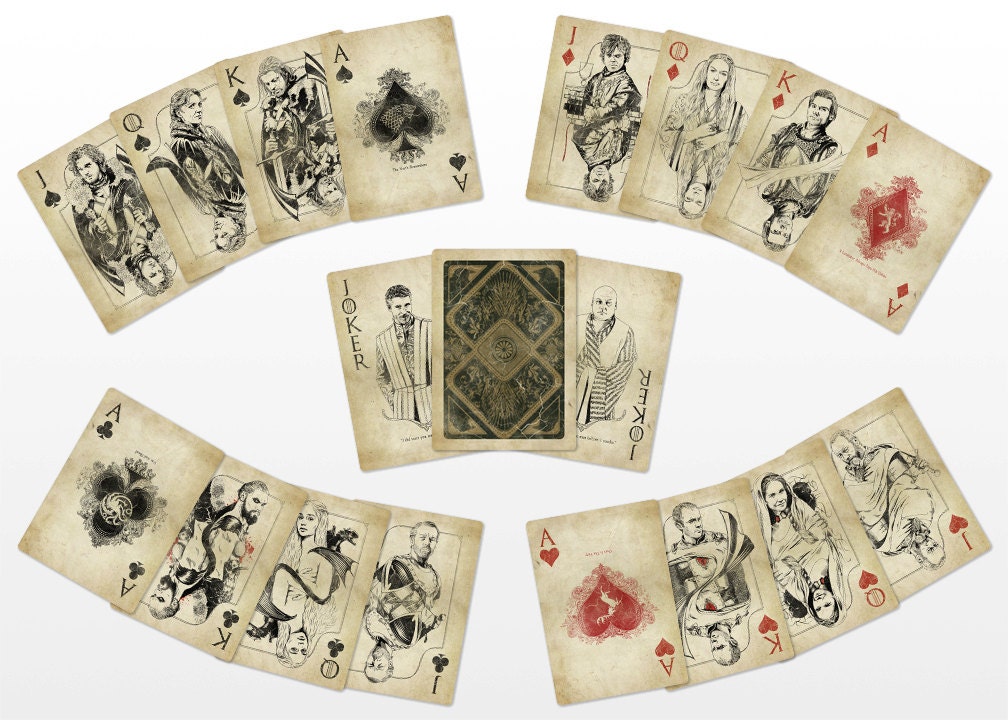
Instead of dice for encounter checks - savage hexcrawl uses cards. Savage Worlds already uses a cards for initiative, so you should have a standard poker deck handy. During travel, draw card(s) for each hex the party enters. If you draw a non-face card (2-10) nothing happens, it is an uneventful leg of the journey. The party then moves to another hex and you draw again. Don't shuffle the deck if nothing happens - just keep drawing cards. It is not only faster than dice rolls this way, it also means that the chances of encountering something grow as you travel more. 
Drawing a face card (Jack, Queen, King, Ace or Joker) means that the party has encountered something. Now, you get to choose/decide what it is. We will leave random tables alone for time being (it is a topic upon itself) and focus on means of improvising the encounter. \
Now, look at the suit and color of the drawn card.

  • Card Color: Red cards mean that the encounter is beneficial to the players, black ones are unrewarding obstacles. Bear in mind, that the color dictates only the outcome of the encounter., not its nature. Even combat can be beneficial (loot, info, etc.) and a travelling merchant an obstacle (wants to travel with you, party will be more visible etc.).
  • Card Suit: Assign some keywords to each of the suits. Choose whatever fits your campaign most - there is no need for magical phenomena in a low-fantasy setting. The basic keywords I use are: Spades (♠) and Hearts ()  for travelers or creatures. Diamonds () and clubs (♣) for places and obstacles.
  • Jokers: Symbolize a twist of fate, something extraordinary and rare. Red joker means that something good happens to the party and black joker is an omen of something bad. Use Jokers for any idea that is too "out-there" or gonzo for your normal campaign.

Encounters

Use those rules to help you come up an encounter on the spot. If you are not comfortable with coming up with all of this in the midst of a session, feel free prepare few small encounters ahead of time. Create some villages, monster lairs, ruins, NPCs, events- anything that adventurers could find in the wilderness in your campaign. You don't have to decide where they sit on the map - you'll  plug them in wherever needed. Whatever wasn't used this session won't go to waste - note it down so it can be changed, tweaked and/or reused later.
When designing the encounter try to make it a natural part of the world. Ask open questions about the encounter. Places have reasons why they were built, NPCs have goals and needs.   If you add this connection between the encounter and the world, it will root the encounter in the setting and will make it seem like it was always there. Next, create few connections between your encounters. A bandit camp made out of a band of army deserters and a NPC royal investigator tasked with finding them and bringing them to justice create a great adventure hook. Will the players help the investigator and capture the bandits, or maybe they will side with the bandits? Maybe the bandits uncovered something about the local governor and that's why they are running away? What is the governor's secret?

Before you'll leave this post, think of a few encounters for your current campaign. Connect them to the world (why is it here? what is its purpose? How? What? When? Where?). Now connect it to another encounter and see how many plots you can create. Easy, right? Well, you just managed to improvise a good chunk of a session!

25 March 2014

Savage Hexcrawl - Part 2: Looking at Terrain

We are back with the irregularly scheduled content for Savage Hexcrawl! Part 1 focused on the mechanics of travel. This part will look into those little hexagonal areas players will be travelling on. What are they? What do they mean? How can they become a tool for narrative roleplaying? There's only one way to find out! (that's a lie, there is plenty of ways, websites and content about it. Yet, I hope you will continue reading... ekhm, as we were).


What the Hex?

I am using 6 mile hexes in my fantasy campaigns. Why 6 mile? There's a great in-depth explanation on The Hydra's Grotto. But, in a nutshell - it is big enough to hide plenty of adventure and small enough to wrap your mind around it.
Also, Math
If each hex can hold plenty of encounters, how are you supposed to draw it on a map to show each find? The simple answer - you don't. On the map, both GM's and players', you should only worry about the general terrain type of the place. Note each discovered ruins, village and person  with the hex number on a separate sheet, or in a notebook.. We'll comeback to this notebook later, now we will look into what you should have on the hexmap - terrain.

I get bigger!

Mapping and Noting down...

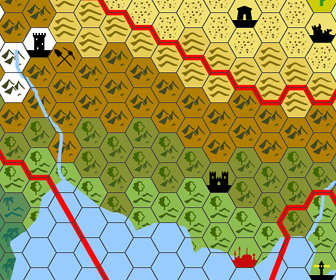
On the right, you can find a (clickable!) table with some basic terrain types for reference. This list is by no means exclusive. Those types will change depending on the genre, campaign or even climate you are playing in. Each terrain is represented by a simple icon and has a cost in movement points (to be used with rules from Part 1). This is the general layout of the hex region and, by extent, how difficult it is to travel trough the area. It doesn't mean that the whole place is one huge swamp, forest, or hill. Just that it is this land's major feature - you need to fill in the blanks.

This is where imagination and some abstraction gets mixed in. Each icon represents a small piece of the game world. Maybe fully fledged by the GM, or maybe full of random encounters - it doesn't really matter. What matters, is that it is a place where many things can happen. Maybe you'll find a small hamlet where you can rest, a canyon that needs to traversed, temple ruins of a long forgotten god that you can explore, or maybe you will just travel trough this land encountering none of those? It doesn't mean that they are not there, they are just undiscovered.


Because each hex can hold so much, it is much easier to jot each encounter down, than to try to represent it on the map. After some time, you'll find that you have plenty of places, people, leads and other details about the game world. Even smallest detail can lead to a whole evening of adventure. It can also lead to nothing, it might be just a random thing that happened. Or maybe it will payout later, in few game days or even few sessions from now. Those notes, combined with hex map will help, both the players and the GM to immerse themselves in the world.


...Enconters

While exploring the lands and discovering new hexes is in the hands of players, the things they encounter in them depend on the GM. Each time players enter a hex, GM will check for encounters (yes, even previously discovered hex, although odds might be different). Encounters can be anything - people, places even the infamous wandering monsters. We will look at encounters, and the system behind them, in the future. Today, I just wanted to show you how much adventure you be found in a single hex. I will leave you with this artwork by the talented Courtney Campbell of the Hack&Slash blog fame. It shows a detailed 6 mile hex. Just a few hours of travel.


24 March 2014

Wild OSR Superstar appears!

Couple weeks ago, I have submitted an entry to Tenkar's Tavern "So, You want to be an OSR Superstar" contest... and to my great surprise I have advanced to the next level with my magic item - Umarlak.

***
I am not an hardcore OSR gamer by any extent. I own quite a few OSR products, but I am yet to run, or even play a campaign with one of retroclones or the good old school dnd. I borrow heavily from OSR into my campaigns though. Sandboxing based on improv is my go-to GM style at the moment. I am in the midst into translating good, old hexcrawl into Savage Worlds. I think that the OSR movement is great and all gamers can benefit from it. And, I think that OSR is much more than a sum of old school dnd and its retroclones.

What I am trying to say, (apart from bragging about the win, of course) is that you should check out the OSR movement. Doesn't matter if you play dnd, Savage Worlds, Fate or anything else. This play style has a lot to offer, and is much more narrative and free flowing than you might think. Also, OSR is not some order of hermetic wizards that will banish you, if you ever approach them without a +2 retoclone of oldschoolity. Go and dig trough the OSR treasure trove, find what you like and use it in your games. I know, that's what I'm will be doing.


This was an OSR Public Service Announcment, sponsored by my ego.

22 March 2014

Savage Hexcrawl - Part 1: Mapping & Travel

Last time on Savage Hexcrawl we looked into the basics of hexcrawl play style. Today, we will look at how the players utilize the hex map to record their travels, map their journey while keeping the game Fast, Furious and Fun!


Mapping

Sample Players' Hex Map
It is players' responsibility to map their journey. They should already have a (preferably numbered) hex grid and pencils for drawing. For the sake of consistency, it's best if one player will be designated the mapper of the group. The mapper will draw the terrain type for each new hex the group visits. You don't have to be an artist - simple terrain type symbols, or even letters are perfectly acceptable. Best time to draw the map is when the GM describes the journey and checks for encounters.
If you want to note some of your smaller discoveries (6mile hex can hold a lot of things!), it is best to use a notebook. Just write the number of the hex and your discovery. Who knows, the party might want to return to it in the future.


Travel

Most OSR systems use some kind of speed attribute to calculate how much a character can travel during the day, then divides it by the hex size to calculate how much the party can travel during a day. All this math does not mix well with the Fast, Furious and Fun idea of gaming that Savage World has. In Savage Hexcrawl we simply use characters' Pace. Trust me, it works. It was not only playtested, but the math behind it works... if you squint a bit. Most importantly, this approach is Fast, Furious and Fun!


Determining party's move speed.

The party's Pace is equal to the Pace of the slowest character. This is the amount of "move points" you have for the day of travel. Basic, plain Hex requires 2 points to travel trough (1 to the center of a hex, another to exit it). A party of humans, in perfect condition can travel 3 of those hexes, roughly 18 miles in a day (6 to 8h of active travel, and few hours for stops, food etc.).
Various factors can affect characters' Pace, and by extent can change  the amount of points the party will receive for the day. Using vesicles or mounts will allow you use their Pace. Many other things will hinder your speed - most importantly fatigue and injury. Each point of Wounds and Fatigue lowers your "daily Pace" accordingly, even if you are riding a mount or driving a vehicle. If you are lucky enough to be a passenger - your are skipped when determining the lowest Pace. Suddenly, a donkey cart is not a bad investment.


Cost of Travel

Now that you know how many move points the party has for the day, you can start your journey. It is easy to travel on flat plains or on the roads. This way you can travel nearly 20 miles a day. Other terrains are not as fun to travel trough. 
Each terrain type has an assigned point cost to travel trough it. It starts from 2 points for easy travel trough plains or on the roads. Places like forests, hills or deserts will have a cost between 3 and 4, while going trough Mountains can will cost 6. Other things, like encounters, severe weather or crossing a river can add to this cost. So while in theory, a party can travel 3 full hexes each day it does not happen that often in practice.

Exploring a Hex

So far you know how to travel, but where is the promised exploration, you ask? Fear not! When you enter each hex, the GM will check if the party stumbled upon anything - most of the time they won't. But each hex can hold many secrets - small villages, ruins, travelling theater trope etc. If you want to explore what the area holds, the party can spend a move point and one player (let's call him the expedition leader) can make a Notice check wit a modifier designated by the GM (usually a minus). This symbolizes the party slowing down and exploring, instead of just traveling trough the hex. You can retry the Notice check as many times as you want, but each time, you need to spend a movement point. 


Camping

Travelling for a whole day in the wilderness is tiring. The party needs a good night's rest to recharge. When or they decide to stop travelling for the day, one character needs to test Survival Skill to find a good place for the camp. Any remaining movement points are added to the test on 1-to-1 basis. For each Success and Raise the party chooses a card suit. When the GM checks for encounters during the night, the party can ignore any encounter of the chosen suits (their camp is well hidden, they see the threat beforehand and know how to avoid it etc.). Critical failure on the Survival test means that the party wanders most of the night looking for a place to sleep - the characters will suffer a level of Fatigue for the next day.


Other


  • Feel free to use the rules for Dramatic Interludes to spice up the travel even more - after all, you are not just travelling in silence.
  • Don't be surprised that you won't encounter something each day. The campaign timeline, events or the fact in which hex you are can change the encounter chances.
  • If you encounter something that you are not prepared to tackle - don't be afraid to back away. You can always come back here later and check it out.


Next time we will go into more detail about the terrain types and what they can hold. Stay tuned!

21 March 2014

Savage Hexcrawl - Intro

As I am toying more wit the "fantasy as an alien planet" stetting idea for Savage Worlds (as first mentioned here), I find that i could use rules for hexcrawl to reinforce the theme of exploration of an unknown world. In this series of articles, I will try to adapt the hexcrawl play style to Savage Words. Let's start with some hexcrawl basics and theory...

What is Hexcrawl?

Hexcrawl is a technique for running wilderness (or wasteland, or space, or any uncharted lands) adventures. It provides rules for travel, exploration and encounters. It is usually paired with sandbox style play to create a truly open world game. In a nutshell - it adds rules to, and expands upon the "you have been travelling for 3 days" parts of RPGs.


Hexcrawl is not a new idea - it existed in the beginnings of the hobby. Companies like Judges Guild, among others, produced modules for this gaming style. Hexcrawl was loosing its popularity to the ready-to-use adventure modules that, where the new hotness in the 80s and was somehow lost in the folds of time. It resurfaced recently thanks to the OSR movement. This is when I got hooked.
The idea behind hexcrawl (and the origin of its name) is that a map of the game world is expressed on a numbered, hex(agonal) grid. Each hex represents equally sized area (Savage Hexcrawl uses 6 miles hexes) of a certain terrain type and can hold many encounters. This creates a game board of sorts, that players will explore.

The GM prepares the map of the lands ahead of time. He fills it with terrain types, cities, rivers, roads, etc. Non-lazy GMs will create adventure sites and possible encounters for some, or all the hexes. Others (including myself) prefer using random tables and improvisation. Use of randomized content is often seen as a necessity in hexcrawl or sandbox gaming. The truth is, you don't have to use it if you don't want to. You can prepare adventures and encounters ahead of time and plug it in during the session. Most GMs use middle-of-the-road approach, with some prepared and some randomized content.

Players receive a corresponding, but incomplete version of the hexgrid map. Depending on the campaign, they might be given a small known area (few hexes here and there), location of a major cities or some other landmarks. Even a blank hex sheet will work (this is what I'll be using for my campaign). The players will explore the area moving from hex to hex, completing their map and encountering all kinds of people, places and adventures.

If you are thinking about running a campaign where exploration is the main focus, you should give hexcrawl a try. It can the simple "your travel for X hours" into a a whole adventure on its own and adds a"gamey" aspect to travel. 

Next time we will look into how to incorporate hexcrawl into Savage Worlds, while still keeping it Fast Furious and Fun!

07 March 2014

Campaign Idea - Fantasy World as an alien planet

I was thinking about this campaign idea for a while. What if PCs in a fantasy world, are actually humans sent to a distant, alien, but earth-like planet on a mission?

This idea first occurred to me when reading Polish fantasy book series - Pan Lodowego Ogrodu, by Jarosław Grzędowicz. In the books, the main character is sent to alien planet to find some missing scientists sent there by earth years before. This world, is inhabited by human-like creatures (minor differences in looks), who have achieved early middle ages (maybe late antiquity) technology level.
Earth is abiding laws similar to prime directive, so they make the main character look like one of the inhabitants and equip him with appropriate weapons and clothing. Communication with Earth is non-existent.

If you ask me it is a great idea for a RPG campaign! It gives the players a reason to stay together and explains the out-of-game knowledge the players might posses. This can also explain why PCs are leveling-up quicker compared to other people (nanites?). It also makes for a great GM tool - you can easily introduce strange creatures and alien vistas to the world. Players can have limited intel about the layout, customs and creatures of the world - this would make for a great Sandbox style campaign. Where focus is put on exploration and discovery. Maybe their mission is to map a portion of the world (Hexcrawl?). 

This idea can be summed up in few points:
  • Players are humans sent from technologically advanced Earth on a mission.
  • Players will look and be equipped accordingly thanks to the Earth's technology.
  • Communication with Earth is limited or non existent.
  • The planet is a low-fantasy world - magic is rare (and unexplained by humans).

I might tinker with this idea more and run in the future on Savage Worlds.
What do you think? Do you know of any similar campaigns?

12 December 2013

Remembering TheForge.pl

So, here's something you probably don't know:

There was a company, started by few amazing artists, that created high quality system-agnostic, fantasy RPG products. It was known as TheForge.

TheForge was usually releasing products describing locales, from towns to taverns, and everything in between. The pdfs were full of very atmospheric pencil drawings, showing vistas, items and floor plans of the described places (that you could use and handouts during session). Each product was loaded with adventure hooks, and simply perfect for low/no-prep gaming - just drop the players into one of those locales and let them explore. I have used their products heavily during my Savage Worlds Fantasy campaign and in early 2000s even done some writing for them. 

Sadly, this company is no more. Well, they still have an RPGnow store running with some of their work (mostly art to use in your games, not the good stuff) - but that's it - no website, no contact with the original creators. Maybe they have moved with their lives, maybe the market wasn't ready for their products, who knows? But TheForge had released some awesome products. Best of all? Their best pdfs were free!

Why am I writing this? Because I want to share and showcase their work. The website is still accessible trough the wayback machine - not all of it, but enough to get your hands on some of those awesome and FREE pdfs! And maybe, just maybe, someone out there will read this and find a way to contact the original creators - because quite frankly, I would be privileged to team up with them and write products like that in the future. And with OSR on the rise, I bet, that pdfs like that would be popular.

So head to TheForge.pl wayback machine and grab yourself some of those awesome products; you and your players won't be disappointed! Start with Fish Side and go from there - many of the pdfs describing buildings, are about places from Fish Side. All of them combined make for a fine mini-setting.
And if you like what you see - go to their RPGnow store and buy something as a thank you, even if they don't know why, I am sure they will appreciate it greatly!

I tip my hat to the guys from TheForge.pl

06 December 2013

Introducing Randomday

NEW! As seen on the Internet! Saves Times and Money! 

RANDOMDAY RANDOM TABLES

What?
Randomday is a random table "feature" of this blog that will take place on a random day at least once a week. It even has a tag and everything - so you know it is official and professional. Randomday is a place for system agnostic tables for role-playing games spanning across different genres... but will probably start with generic fantasy.

While OSR in it's nature, I believe that even non OSR games can benefit from some fine narrative randomizer (as written here). I will try to create each random table based on a question that can show up during play, and make results interesting enough that they'll spawn at least an interesting scene. I am using tables like that to add some fluff and detail to my games, but feel free to use them as you wish.

How?
The rules are simple. You have a detail that needs filling, either for a pre-planned scenario, or something that came up on the spot. You get a random table that has a question/topic that you need, you check the die/dice needed for it, roll them and you get your detail! ...or you can just choose whatever you fancy. The rule of thumb is, that high results are good for the players and low are bad.
BUT WAIT! That's not all! You can use the tables as inspiration for your games, maybe scene/adventure seeds, maybe idea for a magic item, or an NPC? Use it in any game you want, as the tables are supposed to be a narrative and system-agnostic fuel.

Why?
I decided to create Randomday for many reasons; because I feel random tables (when used correctly) create great RPG experiences, because I appreciate your readership and something like random tables is a quick way for me to give something to you that you can use during your games, and because I want to keep myself motivated to post more often. I have few big('ish) projects going on now and it would take weeks, if not months, before I can deliver something worth sharing... so in the meantime, I will make myself create some random fluff for RPGs, hopefully you'll find Randomday tables as much fun to read and use, as I have them to read.

I like it! What should I do?
Feedback is always a great reward, comments make me happy and motivated, but if you would like to help, drop a comment with a topic idea for a random table - the more eclectic collection of random tables we will have, the better; I am also planning on periodically releasing a free Randomday pdf, collecting those tables - so you will be able to see your name/nickname in a electronic booklet that will probably reach tens, if not dozens, of readers!

So check-in on a random day each week, for some random fun!

18 January 2013

Roleplayers! Don't be afraid to Rollplay!

Disclaimer: Before we get to the topic at hand, I feel the need to highlight that I have not grown up in USA and I might have a different view on RPGs' trends and history. For example, D&D was never that popular in Poland. There where far fewer players of DnD, than of Warhammer, World of Darkness or Call of Cthulhu. Because of that, Polish roleplaying scene in the 90s and early 2000s was more saturated with dark and grim motives, and more narrative play, than leveling up and overcoming powerful enemies. So, while the statements about RPG fandom might not be true where you live, the rest of the article can still be of use to you.


There seems to be an understanding, that rollplaying (having your game centered around the dice rolls) is somehow lesser to focusing on the story and acting in character - in other words - roleplaying. But, the fact is, that rolling the dice and having unpredictable results is a big, fun generating, chunk of any RPG session... and was for ages. In the old-timey times of RPGs (so 70s and early 80s) rolling dice to generate the narrative was a normal thing to do. With the advent of TSR products (especially adventures), gamers abandoned this method and turned to more scripted way of playing - something that, the mainstream experiences to this day. Don't get me wrong - I am glad we have this approach - producing adventures and expansions for RPGs allowed the publishers to stay afloat, allowed gamers everywhere to experience narrative ideas of other people and expanded our hobby in new and exciting ways. Unfortunately, somewhere along the way, we, as gamers,  lost the ability to skillfully benefit from random dice rolls in a narrative way. This article aims to bring back some of that old-school charm, show you the benefits of using some random fun in your game.