Pages

Showing posts with label Improv. Show all posts

10 July 2014

Magic: The (random) Creature & Adventure Generator

..or how to use Magic: The Gathering cards for improvisation and inspiration in RPG.
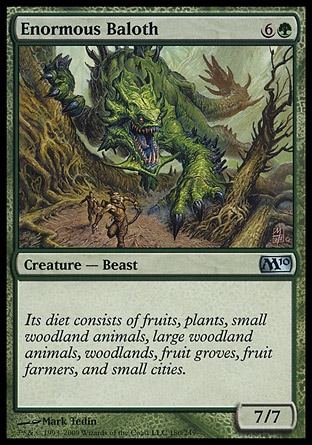
I just stumbled upon an interesting Gnome Stew's article: Troy’s Crock Pot: Draw a card, any card. Author Troy E. Taylor shows you how you can use your Magic The Gathering cards to create a quick and handy random creature encounter deck. It is an interesting read, but it simply boils down to "Hey, why won't we use those cards with great art as a random creature table?". There is much more you can do with Magic cards in a RPG than just draw creatures from it. 

When I was still playing/collecting MTG I used those cards as a big source of inspiration for my fantasy adventures. Now, after I sold all of mine MTG cards I am using a website that has every MTG card scan known in existence - magiccards.info. If you are looking for something less high fantasy in style, you can always find scans from different card games - Card Game Database is a good starting point. If you search around the interwebs enough, you can find full card scans of almost any card game.

In this post I will focus on MTG cards, but those techniques apply to any card game - all you need is some evocative art and some text.
Savage Magic Creatures

Before we jump into different ways of using MTG cards I want to make a quick note on how use the Troy's random creature deck technique in Savage Worlds. Basically, you use it as described - but instead of creating stats for every single card, just choose a similar creature from bestiary and tweak it a bit. There is no need for fine-tuned creatures, especially if they are only used for random or one-off encounters.

I won't be uncovering uncharted lands here if I say, that all you should be re-skinning monsters. It is a good practice for a system like Savage Worlds that can save you a lot of time during unplanned sessions. Use any Savage Worlds bestiary you can find (there is a good free one here). Once you have chosen the mook add extra Edges or Monstrous Abilities to make it more thematic. Consider the card's name, type, special rules and flavor text as well as art when you decide what creature to base it on and what to add. When choosing the base creature - get something that poses a similar threat instead of something not just looks alike. You will have a much easier time tweaking the stats this way.

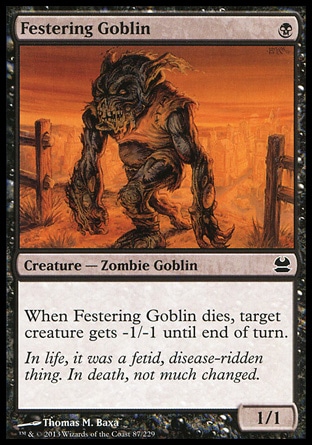
For example, the Festering Goblin (found using the Random button on magiccards.info) above can use the statistics of a normal Goblin from Savage Worlds Deluxe Bestiary with the "Undead" Monstrous Ability added (he is a zombie after all). On top of that I would add something to represent his ability "When Festering Goblin dies, target creature gets -1/-1 until end of turn.". I see it as when you strike the final blow on this guy, all the maggots, spores or gases crawl out the carcass. It is not a powerful ability (-1/-1 in MTG is not a huge deal) so let just say 2d6 damage in Savage Worlds terms. That gives us an ability: 
  • Disease-ridden: Upon death all the corpse releases all of its disease spores and gases. All adjacent creatures must pass a Vigor test, or suffer 2d6 Damage.
Just like that we have created a new, thematic Savage Worlds monster based on the card. It has a interesting gameplay mechanic (exploding bodies, seen in so many video games) that can surprise the players. 

But Wait! There's More!

Drawing random magic cards can also  be used to create detailed adventure plots. While this won't give you a completely polished scenario, it will give you enough info for a hook and background for a session. It will guide your imagination and create possible scenes in the adventure. It is up to you to connect those seemingly random elements into a cohesive whole. You will draw (or use the random function from the magiccards website) to answer few questions that will generate the scenarios background. In the most basic format you should answer 4 questions: Who (the threat is), What (he plans to do), Where (it takes place) and Why (is he doing it). 

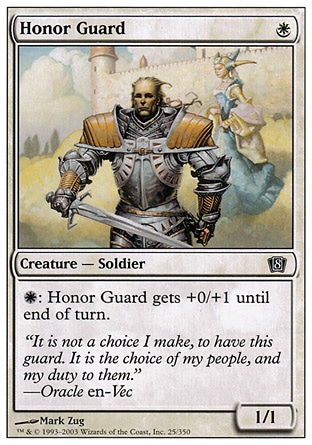
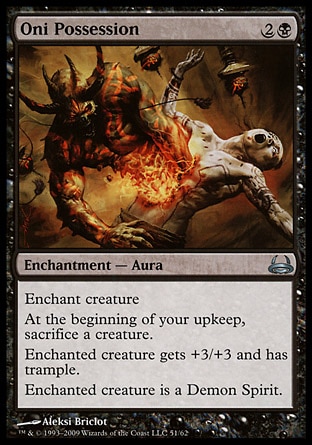
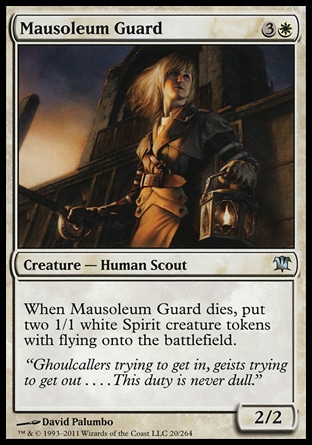
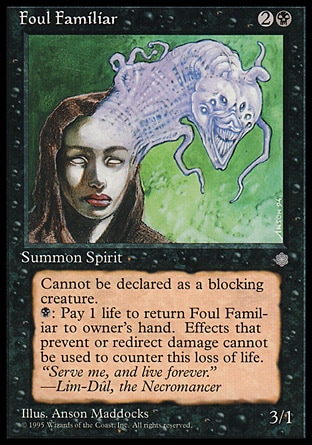
Let's take this technique for a spin, shall we? (I am choosing the cards below at random. I will click random tab on magiccards.info until I get something that fits). I have randomly chosen the following 4 cards (I skipped quite a few cards. I just chose things that looked cool and seemed to fit. This part took me around 10 min):

Who?
What?
Where?
Why?
So, the villain of our piece will be a local honor guard. He seems to be possessed by a demon (Oni). Our key location is a mausoleum and the reason for all of it is a Foul Familiar. It may seem like a bit of random elements, but I already have a scenario idea in mind:

A Honor Guard has is trying to kill a strange phantasmic creature that takes control of citizens in his domain (took this solely from Foul Familiar's artwork). The Foul Familiar is a ghost of a person who was not ready to die and just wants to have a body again. He possesses people who are close to the mausoleum (where their body rests). It would all have been well, if the Honor Guard didn't start tracking it - now the spirit will try to posses someone and escape to have a "normal" life elsewhere. Unfortunately, the guard was very determinated to find out what is making people act strange. He was not able to trace it under normal circumstances, so he made a pact with a demon that will help him track this - what he believes is a- monstrosity. The way the Guard sees it - it is all for the greater good, he is protecting citizens by sacrificing himself. He plans to go into exile once he has done this duty (he's a honorable man after all). Aided by the demon, he is able to track the creature's current host, but any attempts on killing the creature end up in the host being dead (either from the Honor Guard's hand, or by the creature escaping from its host and taking its life with it). Now, the city is in terror. People start dying in mysterious ways and the town guard (of which the Honor Guard  is a somehow high ranking member) seems useless to stop it (after all the only the Honor Guard can see the creature, he slows down the investigation to finish his duty). This is where the players come in. Someone (a family member of one of the recent victims perhaps?) hires them to solve the crimes. What will players do when they find out it is an esteemed guard who is committing the crimes? Is he really following his duty, or is he so far under the demon's influence that he does not see he has become a villain?Will they side with the Guard or the Spirit?

Can you see how those few cards make your imagination going? While this is just a setup, I could write a whole scenario out of those 4 cards. Alas I am a lazy GM so I would much rather improvise from this little setup and see what players would do. I would probably prepare few previous murders for PCs to investigate, some NPCs with whom they can interact and go from there. So far, this whole thing took me a little over 30 minutes.

Once you are confident with creating something out of those 4 cards, feel free to ask yourself more questions and get more random cards as your answers. This way you can create a very detailed adventure...or a very detailed background that you can easily improvise from. Go on, give it a try and tell me what you think.

06 July 2014

Who, What, Where, When, Why, How to improvise - part 2

In Part 1 of this article we established that a key to successful improvisation is to “Ask questions and use the answers”. If you want to create more fleshed out details you should ask yourself more than one question. Feel free to use a variant of the 5Whys technique. Don't concentrate on just the Whys - use any open ended question word (Who, What, Where, When, Why, How) you can/want to get more interesting answers. 

Before we move any further, try improvising some content for your current game from one of the questions below. Ask yourself a chain of at least 3 questions based on your previous answers to see what you can come up with. To get detail - think about your current game - the setting, the player characters and their past.

  • Who lives in this house?
  • What does this stranger want from you?
  • Where is the artifact hidden?
  • When will the assassin strike?
  • Why is there blood here?
  • How did this beast got in here?


It might seem tricky at first to come up with good answers on your own, but don't be discouraged. The goal of this silly exercise is to make you more confident with asking yourself open ended questions when fishing for answers, not to come up with great answer. Inspiration for great content will come to you as you play the game - party's previous exploits, setting details or even a piece of art... heck, maybe even one of those dreaded random tables! 

Now you know how to create some random content on the spot, let's see how to use it during a game.

Where to Start?

First of all, don't be afraid to fail when you start. Not everything you come up with on the spot will be gold. Even with years of practice, some things that you will come up with won't be great - and I speak from personal experience on that front. Don't get discouraged

When you are stating tinkering with improv, create a "safe space" in your game where you can fail and it won't matter. You can use a trick that I was almost abusing when I was starting - creating "side quests".

Prepare for your session as you would normally. 
As you do, identify some spots in the adventure, where player characters have some down time or are doing something that requires a lot of time - travelling, investigating, research etc. Now think of a few small things that COULD happen during this time. Ask yourself "What can happen to the [player] during [x]?". Meeting strangers while travelling, getting pick-pocketed while in a busy market - that sort of things. Write down few of those small things. If you want to experiment with random tables - come up with 6 things, so you can roll a D6 to find out what happens during the game.

As you get to this spot in the adventure, choose one of the things to happen to player characters. Let them interact with it. They will you some questions about the encounter and from that you can come up with some answers using the open ended questions. Just ask yourself a series of them in your mind and come up with something - anything. If it is not a great answer, nothing is lost - PCs will continue down your planned adventure. If, however, some of your answers will spark the players imagination - they will follow this little unscripted plot. Now you will have to ask yourself more questions to create more content. (Pro Tip: If you are short for ideas on the spot, excuse yourself to the bathroom or to grab a drink - use this time to come up with something juicy).

The beauty of this "side quest" approach is that you can stop it an any time without disturbing the overall plot. So whatever you come up with, you won't work yourself into a corner - plotwise. This way, you can't lose!
A word to the wise: before you start doing this often, tell your players that random things can happen to their characters. After all - it is a living world and not everything is connected to the adventure at hand.

What and When to Improvise?

When you are starting out, you should focus on improvising small details and adding some side quests for flavor. Add random details to the scripted content - maybe use a sense that you don't normally cover in your narration. Smell can be a powerful tool here, just add random smells to NPCs and locations. Add some small details to anything you can. A shield the PC found is not just a generic shield, it has dents, old blood stains and has a coat of arms of a local barony on it. Suddenly everything in the game world will seem more alive and complete. From that, players will ask you questions. Who did this shield belonged to? Did we just kill a noble? 

Those questions should be a trigger for you. They are an opportunity. They mean that the player is interested in some aspect of the world and they want to investigate it further. You want to answer those questions. Each of them is a potential side quest. And you know what a collection of interconnected side-quests is? A whole adventure. Unscripted! Just like that! 

Your players are your biggest asset when it comes to sparking your imagination. They will give you the ideas that you can develop on the spot into plots. Adventures created this way will seem more organic, more connected to the characters. You no longer require to come up with mysterious strangers to give the PCs a task. Players themselves are being proactive into creating their own adventures. You bait them with some random detail, and they will basically create the scenario for you. It's that simple - all you need to do is to answer some questions!

Go! Start Improvising!

04 July 2014

Who, What, Where, When, Why, How to improvise - part 1

If you followed this blog for a while you know that I love all kinds of improv in my tabletop roleplaying. I am pushing things like hexcrawl and random tables down my readers' throats for quite some time now... and will continue to do so. Don't get me wrong - I enjoy scripted adventures as much as any of you, but the constrains of adult life usually stop me from preparing those. So I turn to more free-form games - narrative RPGs, story games - basically things that were created for zero prep gaming. Those are great, but usually not suitable for long-term play. So, if I want to run a long term campaign in a traditional RPG, I improvise a lot.

And so can YOU!

The aim of this article is to show you how to start improvising during the game. I want to focus on the basics and give you the tools, so you can start tinkering with improv yourself. My approach to improv is by no means the only way to improvise during session, but it is something that has worked for me for years. I hope it will do the same for you.

Why Improvise?

I started improvising my games because I had less and less time to spend on my session prep. If you are having the same issue, I strongly encourage you to give improv a try. Even if the session is not as polished as a fully preped one, it is still better than no session at all, especially when time is a valuable commodity.
I kept improvising, because this style of GMing gives me a similar feeling to that of a player. The sense of wonder, discovery and surprise that every session brings. You won't know what hides around next corner. While you might know who the bad guy is, but you have no idea how the players will stop him. If you had been GMing for a long time, this approach will feel like a breath of fresh air. Not knowing all the details of the plot might seem a bit scary, but trust me, it is very rewarding and will create amazing stories.
Lastly, the way I improvise (or maybe just explain improvisation) includes some techniques that you will find helpful in your life away from table. They are are used in training programs for journalism, management and general problem solving. While I might sound like a snake oil salesman trying to push some dodgy product on you, those techniques (even if looking and sounding silly) can help in your everyday life.

Who Can Improvise?

Anyone!

No, honestly - anyone can improvise. It is a skill and like many others, can be learnt. Wannabe actors pay good money for improv classes. You, as a tabletop roleplayer, have a head start. If you had even been a player - you have improvised. If you ever had to wrangle players back to the plot while GMing - you have improvised.

It might not seem as such, because it was just a small part in a larger, pre-scripted, scenario. But this is exactly how you start. No one is asking you to start a session with 0 preparation and come up with an amazing story right away. I want you to start small and level up your improv skill over time. Improvisation is an art that builds up on input of others. In tabletop RPG terms it might be your PCs' past exploits, their background and their knowledge. It will also be based on the rules and contents of the world you are playing in. Lastly, the extra input will come from the players themselves - your friends around the table. Don't be afraid to share the improv load.

How to Improvise?

This is it. This is the Holy Grail that you traveled here for. Gone trough all those lines of text. Dear gods, so many letters! Now, the secrets to successful improvisation lay before you. Finally, you discover that to become an Improv GM you have to...

Ask Questions.

I know, I know. It seems quite disappointing, but this is the trick to improvisation during a session. Whenever you need to introduce some unscripted element in your games you need to ask yourself few open ended questions. You know, those questions that start with Who, What, Where, When, Why and How. They are called Five Ws (or as I knew them in the UK, 5 bums on the rugby post) and are commonly used in nformation-gathering. This is the exact formula I am using when I need to come up with something on the spot.

Let's say I need to introduce a NPC. I will ask myself few questions about him. How does he look like? What is his agenda? Where do players meet him? I go trough the same process with places, items, even with players questions: "What's in this castle?"

You don't have to answer all the questions that come to your mind. Answer the ones you can and go from there. Keep your answers within the boundaries of the setting. The castle might be owned by a baron who dabbles in necromancy in a dark fantasy, or it can be overrun by monsters crawling out of a portal in the dungeon in a heroic game. Each answer should lead you to a new question. Why does the baron want necromantic powers? Where does the portal lead to? Don't be afraid to introduce details from the PCs past. The baron has gone corrupt after you cleared out his black market and killed his lover, he wants to bring them back. The portal leads to a dimension where you banished that demon - he plots revenge by opening it near you. With a little practice you will be able to create content for your game like that in seconds.

Bottom line, to be good at improvisation you need to “Ask questions and use the answers”. Just remember to take details for your answer from the setting and the player characters' past - this will create truly memorable encounters.

Oh, one more thing - if you can't think of a good answer for your question, don't be afraid to ask the players. You can do it either "out of character" by just saying - "what do you think is in there?" or root it in the game world by connecting it to the player characters - "You used to serve under barons in this kingdom, do you remember anything about this castle?"

***

It is getting late and the post is getting long, so I will split it in two. Stay tuned for answers to such mind-boggling questions like: "Where to Start?" and "What and When to Improvise?"
Edit: Now you can check out Part 2!